
“ପ୍ରଭାତର ପବନେ ଟଗରର ଗନ୍ଧ, ଝୁନାର ଧୂପେ ଘରେ ହୁଏ ଆନନ୍ଦ।”
(In the morning breeze drifts the fragrance of tagara, With jhuna smoke, the home fills with joy.)
Do you remember how mornings began in our Odia homes? Not with alarms or phone buzzers, but with sounds and scents that were almost like prayers themselves.
The day often started before sunrise. Somewhere, the chak-chak of a broom swept the courtyard clean. A koel’s song mixed with the radio playing bhajans from All India Radio. The faint splash of water from the well or hand-pump announced that life was stirring.
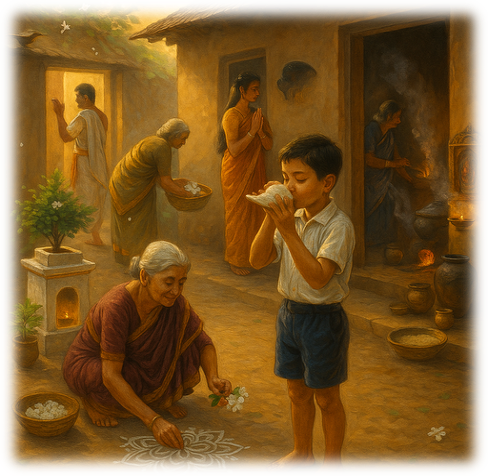
Who in your family went out to pluck flowers? Was it you, with a small basket in hand, searching for white tagara still wet with dew? Or your grandmother, bending slowly to pick hibiscus for Lord Jagannath? Sometimes, children argued over who would blow the conch (sankaha) later – a small but sacred privilege.
The courtyard, freshly swept, was sprinkled with water and decorated with jhoti (decoration patterns of rice paste). Grandmothers bent low, their fingers moving in graceful curves, painting sun, moon, or lotus motifs on the ground. Those designs weren’t just decoration; they were invitations to divinity.
Bathing was next – not just for cleanliness, but for purity. Fathers tied their gamuchha, mothers slipped into crisp cotton sarees, and children wore uniforms. Do you remember that faint crackle of a stiff new dhoti or saree?
Inside, the shrine glowed. A brass lamp flickered, camphor hissed as it melted, jasmine garlands were hung with devotion. The smoky sweetness of jhuna dhoop drifted slowly through every room. Even today, one whiff of jhuna can take us straight back to childhood.
The Tulasi chaunra stood in the courtyard, glowing in the first rays of the sun. Someone circled it with folded hands, whispered a prayer, and poured water at its roots. The Tulasi was not just a plant – it was a silent guardian of the home.
Meanwhile, the kitchen was already alive. Rice bubbled in brass pots, dal simmered with turmeric, vegetables were cut early so they could be offered first to the deities. On some days, there was bara-aloo chakata or warm milk for children before school. In summers, cool pakhala bhata refreshed everyone; in winters, hands were warmed over a coal stove before the first meal.
And then came that moment when everything paused – the conch was blown, bells rang, voices echoed “Jai Jagannath.” For a few seconds, the home was no longer an ordinary house. It was a temple, and every member was part of the ritual.
Village or town, the rhythm was the same. In villages, mornings included feeding cows, carrying water, and calling out to neighbours. In towns, it was the bicycle bell of a milkman, the chatter of children rushing to Ravenshaw or Stewart, or the clatter of typewriters starting in nearby offices.
By the time the sun was fully up, everything was done – puja, food prep, cleaning, prayers. Fathers left for work, mothers continued their endless duties, children ran to school. The home had already lived a full half-day before the world outside had even begun.
Today, life is different. Alarms replace the conch. Incense sticks replace jhuna. Jhoti is rare, radios are silent, and mornings feel rushed. But close your eyes, and those old rhythms return – the koel’s song, the fragrance of tagara, the smoky swirl of jhuna, and the echo of “Jai Jagannath.”
Some memories never leave. They live in us, like the morning itself.
“ଘରେ ଘରେ ପ୍ରଭାତର ପୁରାଣ, ଜଗନ୍ନାଥ ନାମେ ଆରମ୍ଭ ହୁଏ ପ୍ରାଣ।”
(In every home, morning is a sacred tale, With Jagannath’s name, the heart begins its day.) Morning in an Odia home was never ordinary. It has been a ritual, a fragrance, a prayer – and above all, a memory that still lingers.

The vivid portrayal of Odia morning rituals—such as temple offerings, the fragrance of fresh rice, and the gentle melodies that fill the home—beautifully celebrates the warmth, spirituality, and sense of belonging that are at the heart of Odia culture. Thank you for capturing these cherished moments which keep tradition alive and connect generations through everyday acts of love and faith.