
“ଯୁବପିଢ଼ିର ଶବ୍ଦରେ ଅଛି ଆଗାମୀ ଉତ୍କଳର ସ୍ୱପ୍ନ।”
(In the voices of youth lives the dream of tomorrow’s Utkala.)
One Independence Day in Thane, a young boy walked into his school in a Sambalpuri kurta. His friends asked curiously, “Which state is this from?” With pride in his eyes, he replied, “From Odisha – the land of Jagannath.” In that simple moment, history and heritage found a voice through a child.
This is what it means to be a young Odia outside Odisha – carrying a legacy, sometimes quietly, sometimes proudly, but always carrying it forward.
Parallelism of Two Worlds
At home, mornings begin with Jai Jagannath, dalma simmering in the kitchen, and stories from grandparents. Step outside, and life is filled with Ganesh Utsav pandals, dhol-tasha beats, and cosmopolitan Mumbai culture.
Do we know how to write our name in Odia? Do we know why Raja is celebrated with swings, or why Kartika Purnima boats are floated? These questions shape the balance between two worlds. For our youth, Odisha often lives in festivals, flavours, and family traditions—sometimes hidden, sometimes proudly displayed.
Culture finds its way into daily life through little anchors.
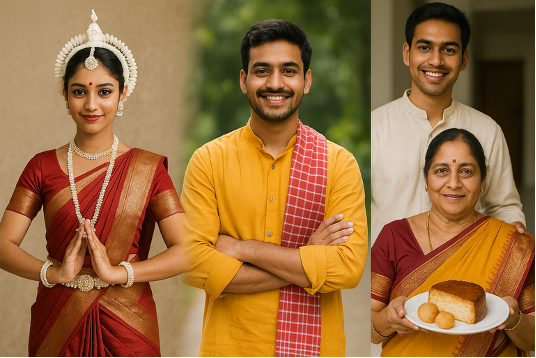
- A girl practicing Odissi steps her grandmother once danced.
- A boy proudly tying a gamuchha during Raja Sankranti.
- Families eating pakhala in summer or poda pitha during Raja, making small homes feel like Odisha again.
“I am learning Odissi because when I dance, I feel connected to my roots.”
Food remains one of the strongest anchors of memory. Chhena poda, Rasagola, or even a simple bowl of pakhala becomes more than taste – it becomes identity.
For today’s youth, technology has become the new temple courtyard – a place where community gathers, traditions are shared, and culture finds new expressions. YouTube plays Jagannath bhajans, Instagram pulses with Sambalpuri dance reels, and Zoom brings families together for Saraswati Puja.
But a quiet challenge remains: Will memory alone preserve our culture? Or will we live it, teach it, and speak it daily to the next generation?
Voices That Inspire
“For me, Odisha means Rath Yatra with my grandparents in Puri. Even in Mumbai, Rath Yatra makes us feel at home.”
“Sometimes my friends don’t even know where Odisha is. That makes me want to tell them more proudly.”
These voices remind us: Odia identity is not about where we live, but how we choose to live our traditions.
Why It Matters
When we speak proudly about Odisha today, we echo a heritage that was once a civilizational powerhouse. A land of maritime explorers who sailed to Java and Bali, a land of magnificent temples like Konark and Puri, a land of saints, poets, and reformers who shaped India’s soul. Odisha was once a beacon of culture and economy.
That pride must not remain in textbooks or grandparents’ stories. It must be alive in the confidence of our youth, who wear Sambalpuri with style, speak Odia with joy, and carry Jagannath’s name with pride wherever they go.
Here in Thane, Utkala Association is more than a gathering of families. It intends to bridge the two worlds. Every cheer of “Jai Jagannath” in our programs is not just devotion—it is training the next generation to hold on to their roots while they reach for the sky.
A Call for Tomorrow
The future of Odisha rests in its youth. And so, we ask:
- What story of Odisha will you tell your friends tomorrow?
- Which part of our culture will you carry forward with pride?
- How will you keep Jagannath alive in your everyday life?
Let us, as a community, give our youth the stage.
- Encourage them to perform in our cultural events.
- Invite them to write for our blog and share their experiences.
- Teach them Odia songs, poems, and stories – not as duties, but as treasures.
Because in their laughter, questions, and leadership, Lord Jagannath will always be alive.
“ଯୁବପିଢ଼ିର ଶବ୍ଦରେ ଅଛି ଆଗାମୀ ଉତ୍କଳର ସ୍ୱପ୍ନ।”
(If in their voices lives tomorrow’s Utkala, then in our hands lies the responsibility to nurture that voice.)
