
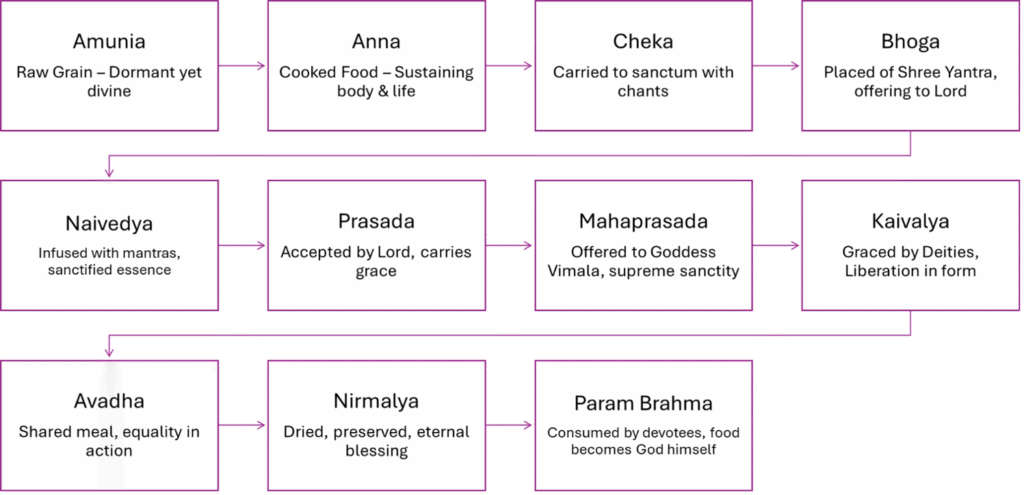
Inside the Jagannatha Temple, rice undertakes a cosmic journey – from humble grain to the taste of liberation.
“Annaṁ Brahma – Food is the Divine itself”
The Sacred Idea of Anna in Jagannath Tradition
In Jagannatha Sanskriti, food is never mere sustenance. It is divinity in motion – the bridge between human effort and cosmic grace. Of all foods, rice, or Anna, is supreme. Its journey from a raw grain in the field to sanctified Mahaprasad of Puri Jagannath Temple is a profound allegory for the soul’s ascent from potential to liberation.
This is not a metaphor created by poets. It is a living ritual, enacted every single day in the Jagannath Temple kitchens, known as the Rosha Ghara – the largest temple kitchen in the world.
The Beginning: Amuniya to Anna
The story begins in the fields of Odisha, where the farmer sows Amuniya – uncooked rice grain — into the soil. Humble and raw, yet filled with promise, it mirrors the human soul at its origin. Farmers invoke Anna Lakshmi, goddess of food, while planting.
When fire meets grain in the temple kitchen, the transformation begins. Cooked into Anna, the rice releases its fragrance, filling enormous clay pots capable of feeding thousands.
Here, matter awakens into nourishment – but its destiny is to transcend the ordinary and become sacred.
Crossing the Threshold: Cheka to Bhoga
Once cooked, the rice is carried reverently into the sanctum in a ritual called Cheka. This marks the crossing from the human to the divine. Conch shells echo, bells resound, sandalwood smoke rises, and the steaming rice enters the holy sanctum of Jagannath Temple.
Placed upon the Shree Yantra, it becomes Bhoga – no longer food for mortals but an offering of surrender and gratitude to the Lord.
Sanctification: From Naivedya to Prasada
The sanctification deepens. Priests chant Vedic hymns, infusing the offering with sacred sound. The rice becomes Naivedya, charged with vibration and awaiting divine acceptance.
When Lord Jagannath accepts the Naivedya, the transformation is complete – it returns as Prasada. No longer ordinary food, each grain carries grace. Devotees believe even a single morsel of Jagannath Prasada can heal, uplift, and connect them with the Divine.
The Final Sanctity: Why Mahaprasada is Unique
Sanctification in Puri is never halfway. The offering must be taken to the shrine of Goddess Vimala, consort of Jagannath, without whose acceptance no ritual is complete. Only then does Prasada become Mahaprasada – the holiest food, touched by both Lord Jagannath and His Shakti.
Mahaprasada then receives the glance of five deities. In this collective blessing, the food ascends to Kaivalya – liberation embodied in edible form. To taste Mahaprasada is to taste moksha itself.
The five deities traditionally referred to are:
- Jagannath – the Supreme Lord, presiding over the temple.
- Balabhadra – elder brother of Jagannath, representing strength and stability.
- Subhadra – their sister, embodying compassion and harmony.
- Sudarsana – the divine discus, symbol of cosmic order and protection.
- Vimala Devi – the Shakti of the temple, without whose acceptance Mahaprasad is incomplete.
Together, these five divine forces – Vishnu (Jagannath), Shakti (Vimala), cosmic energy (Sudarsana), and the divine siblings (Balabhadra and Subhadra) – glance upon the offering, elevating it into Kaivalya, liberation in edible form.
History in Every Grain: Chhappan Bhoga of Jagannath Puri
The reverence for Mahaprasada is centuries old. Medieval chronicles describe how Gajapati kings of Odisha ate it alongside commoners, breaking caste and rank. Saints like Chaitanya Mahaprabhu revered it with tears in their eyes, declaring it food that embodied God Himself.
The Jagannath Temple Kitchen (Rosha Ghara) is the largest in the world. Every day it prepares 56 offerings, famously known as the Chhappana Bhoga of Jagannath Puri – from simple rice and dal to elaborate sweets – all sanctified through the same sacred process.
Equality at the Lord’s Table: Aavadha at Ananda Bazaar
Perhaps the most radical expression of this tradition unfolds in Ananda Bazaar, the world’s largest open-air dining hall. Here, devotees sit together in the practice called Aavadha.
Kings and commoners, priests and pilgrims, Odias and foreigners — all eat shoulder to shoulder, sharing food from the same vessels. I once stood amid that sea of humanity, watching laughter rise above temple bells, the fragrance of rice mingling with devotion. For that moment, strangers became kin.
This is Jagannath’s vision of equality, alive and visible: that in His eyes, all are one.
Eternal Presence: The Power of Nirmalya
Not all Avadha is consumed at once. Some is dried and preserved as Nirmalya, carried home as a talisman of protection. Families place it in their Tulasi Chaura, believing even a pinch sanctifies the household.
Across oceans, Odias in the diaspora carry Jagannath’s Nirmalya to distant lands. For them, a grain of dried rice becomes a thread of connection – proof that the Lord is never far, even when home is distant.
The Destination: ParamBrahma – When Food Becomes God
At last, when Mahaprasada is eaten, the journey of rice reaches its final stage – ParamBrahma. It is no longer food but communion. The act of eating itself becomes liberation, for in consuming Mahaprasada, the devotee consumes the Divine.
This is the spiritual voyage of rice in Jagannath culture: from Amuniya to ParamBrahma, from raw grain to eternity. Each stage reflects a truth of life – potential, surrender, grace, equality, protection, and liberation.
In Jagannath Puri Temple, food is not commodity but revelation. Each grain teaches that the Divine is not distant in the heavens; He is here – in the kitchens that feed thousands, in the smoke of sandalwood rising with chants, in the laughter of strangers eating as one, and in the silent strength of a grain of rice turned eternal.
To taste Mahaprasada is to taste eternity itself — for in grain of rice, Jagannath is present: eternal, universal, and infinitely near.

Very impressive